Showing posts with label fossils. Show all posts

Saturday, September 7, 2019

Dinosaurs Again, and Ghengis Khan


Most Complete T-Rex Skeleton Ever Found
2019-09-07 Saturday

We woke up today to gray skies, but the rain had stopped falling. Joey told me he had been up in the middle of the night (I slept like a log!!) because he heard a “strange noise.” Upon investigation, it seems that our oldest water hose had burst. Since it had already been repaired twice, we put “new water hose” on our shopping list.

Despite having the Jeep still hooked up from last night, it still took us a ridiculous amount of time to leave the campground. I took Cassie for a long walk, and she played with another dog in the huge fenced in dog yard, so that was nice for her to get some exercise. Finally, we pulled out just at 11:00. We drove about 15 minutes to the Museum of the Rockies, adjacent to the Montana State University (wrong MSU again!) campus. There was a large RV Parking area, so we were comfortable leaving the RV there while we went inside.

This museum is famous for its dinosaur collection, and it certainly did not disappoint! Montana is one of the premier states for dinosaur discoveries, and the museum focused on Montana in the presentations. This was no problem, because just to name one thing, the most complete T-Rex skeleton ever discovered was found in Montana, and it is in this museum! MSU (the one here, I mean) has a distinguished paleontology department as a result of the rich fossil record in their backyard. All of the displays included the name of the person who first found the bone(s), as well as the team who removed it from the rock. Often these folks were interns or doctoral students studying at this school.

The displays also were excellent in  that the beginning of the dinosaur section included some basics, such as what paleontology is, how the museum handles its samples, and the fact that all the displays included whether it was the real thing (labeled B for bone) or a replica (R). They explained that sometimes the real bones are still being studied. There was even a small lab included, with a volunteer inside working on cleaning some bones. The sign on the door said to “knock if you have a question,” and we actually did that at one point.

Bottom line, we got to the Museum at 11:30ish, and we stayed all day, until 4:00 (it closed an hour early, much to our dismay.) We did take a break to go have some lunch in the RV, but otherwise, we were with the dinosaurs. There were amazing samples and explanations, including the fact that paleontolgists now classify dinosaurs as either “non-avian” or “avian.” Most of the extinct larger dinosaurs are “non-avian,” but a particular class of dinosaur is still alive--they are the “avian” class--which we call BIRDS! I knew that the general understanding now was that birds “evolved” from dinosaurs, but from a paleontological point of view, apparently they ARE still considered dinosaurs. To put it another way, dinosaurs are not extinct! Only some are, the way some mammals (such as the ones we saw at the Ashfall Fossil Beds) are extinct. [Note: Blogger has become impossible to manipulate photos into... so all my photos will be at the end of the blog (I hope.)]

I could have spent a lot longer in the dinosaur section, because I didn’t have time to watch a number of videos, such as one which showed a day in the life of the paleontologists who found a particular fossil. I did sit through one which explained how the microbes and bacteria which we saw at Yellowstone (all those colorful bacterial mats at Grand Prismatic Pool, for instance) are actually examples of what happened all over the Earth as the geologic ages passed. The reason Yellowstone is so fascinating is that we can see for ourselves life forms which survive based on chemicals rather than on light (such as plants.)

Meanwhile, the dinosaur bones were the stars of the exhibit. The T-Rex was found in Montana, and is on loan to the museum. It was found on Bureau of Land Management land, which means it is strictly speaking owned by the American people. It’s on loan from the BLM. The skeleton is the most complete T-Rex ever found, and we were fascinated by the reconstruction. The creature had two sets of ribs, but no sternum attaching them-- Joey told me he thinks they must have been contained by the musculature of the animal.

One thing we noticed (which is what we asked the volunteer worker about) was an odd, long bone which seemed to come down between the two femurs. It looked very odd, and was something we saw in almost all the dinosaurs. The volunteer said she thought the bone was analogous to the pubic bone in people, but here it seemed to extend quite far from the pelvic bones. Joey added while I was writing this that what really freaked him out was the similarity of the “hands” of the bipedal dinosaurs to human hands--they have not evolved that differently. He says he also learned a lot about the comparative anatomy of birds that he didn’t know before-- the scientists who study this stuff do a lot of work with modern animals looking for similarities in bone structures, which helps to understand what the dinosaur’s body functioned like.

Another thing we learned was that some of the features of some dinosaurs, such as the plates on the back of a stegosaurus, may have been for “display”, the way modern birds have colorful features for display (think of peacocks, for example.) So several of the reconstructed dinosaurs were depicted with some distinct colors, with feathers in various parts of their bodies (this is known from the bones themselves.) It was just fascinating. We saw dinosaurs which probably burrowed underground (again, similarities to features in modern burrowing animals), and clutches of dinosaur eggs. Most everything in the dinosaur exhibit was original--there were not very many reconstructions, although the series of triceratops skulls had several reconstructions in order to present a complete display of the animals from when they were babies, through the juvenile stage, to adulthood. The skull undergoes certain changes as the animal ages.

One more funny thing-- I read that T-Rex’s teeth replaced themselves every six months, so the animal went through a number of sets of teeth. This sounds so weird, but the display explanation added, “Humans only replace their set of teeth once during their lives.” Until then, I had never thought of people as “replacing” a set of teeth this way--but of course, that’s what happens when we lose our “baby teeth” for our adult ones. The same thing was true of dinosaurs, only more frequently during their life span.

All in all, this was so interesting, but at about 3:00 they announced that the museum was closing an hour early for a private event. We hadn’t seen ANYTHING else except a movie in the planetarium, on how the earth was created. Joey said it was very good-- sadly, I fell asleep while Jupiter was the only planet, and I missed the rest of the movie. But besides this, there was a hall of “original peoples” of Yellowstone Park, i.e. Native Americans who lived in the vicinity. In that hall there were also posters and photos of the original stores and hotels set up in the late 19th century for tourists. I have to say, we pretty much ran through that section.

To our surprise, when we went into the next room, it had a lot of early 20th century vehicles used in Montana, including a set-up of a gas station, a “sheep wagon” (which looked sort of like a covered wagon with a bed, stove, table, and cupboards--in other words, an RV!-- for the guy who followed sheep herds over the prairie), and a “tar-paper shack”. We looked around for 10 more minutes.

Then we hurried into the last exhibit, a temporary exhibit on Ghengis Khan. We started at the wrong end for that-- and I found it fascinating, but Joey wasn’t as interested as I was. I have a book on Genghis Khan, so I knew his history. Basically he united the Mongol tribes, controlled most of Asia (the idea of the Mongols sweeping down and conquering people was entirely true), and then he implemented a lot of ideas which we still use today, such as diplomatic immunity for political representatives of other areas, the pony express concept (which was described by Marco Polo), national parks (he set aside some of his favorite hunting areas and forbade settlements there), wearing trousers (men wore robes before that, but trousers were much more convenient for riding horses), protection of water sources, religious freedom, the use of paper money (also reported on by Marco Polo), and tollbooths! There was also a brief video explaining that Ghengis Kahn (or perhaps one of HIS ancestors) was the progenitor of a huge percentage of Asian people--discovered by tracing the Y chromosome which unites this large group. So maybe he also populated the countries as well as ruling them!

Ghengis Khan also wrote a code of laws and morality (he lived at the beginning of the 13th century), including such items as, “All religions are to be respected equally,” and “Lies, theft, treachery and adultery are forbidden...whoever violates these commands is to be put to death.”  Joey’s favorite was, “Do not wash clothes until they are completely worn out.” I had to notice this one: “Don’t behave as high as a mountain. Though a mountain is high, it will be climbed by animals.”

All this information was, as I said, at the very end of the large exhibit, and we didn’t have time for most of it (including the information about horses, warfare, etc.) They even had a dance group from Mongolia (which is now an independent nation) so we could learn more about the Mongol art and music-- of course, we did not go to that either. At ten minutes to four, I rushed into the gift shop, looked around hastily, and let them kick me and the last stragglers out of the museum. I could have used the extra hour!! All in all, this museum was absolutely fantastic, and I’m still thinking of going back tomorrow; our admission was good for two days.

From there, we drove to Walmart, where we are spending the night. The wifi reception was excellent, and we were able to watch the entire Michigan State (the right MSU) football game. There was also a home game for the wrong MSU today, and we are joined in the Walmart parking lot by at least 20 other RVs. It is quite remarkable; I have never seen so many overnighters at once. Our guess is that they are here for the game--the RV park we stayed in last night was booked solid tonight so we couldn’t have stayed even if we’d wanted to. After the game was over, we went inside and paid for our free parking with a $200 purchase of groceries, a new water hose as mentioned above, some TV cables to perhaps get local TV stations on my computer, and a pair of sweat pants for Joey, among other items. Now, I just have to fight with my blog platform, in an attempt to upload some of the many museum photos I took today. And then, to sleep!

Comparative leg sizes


Clutches of Dinosaur Eggs

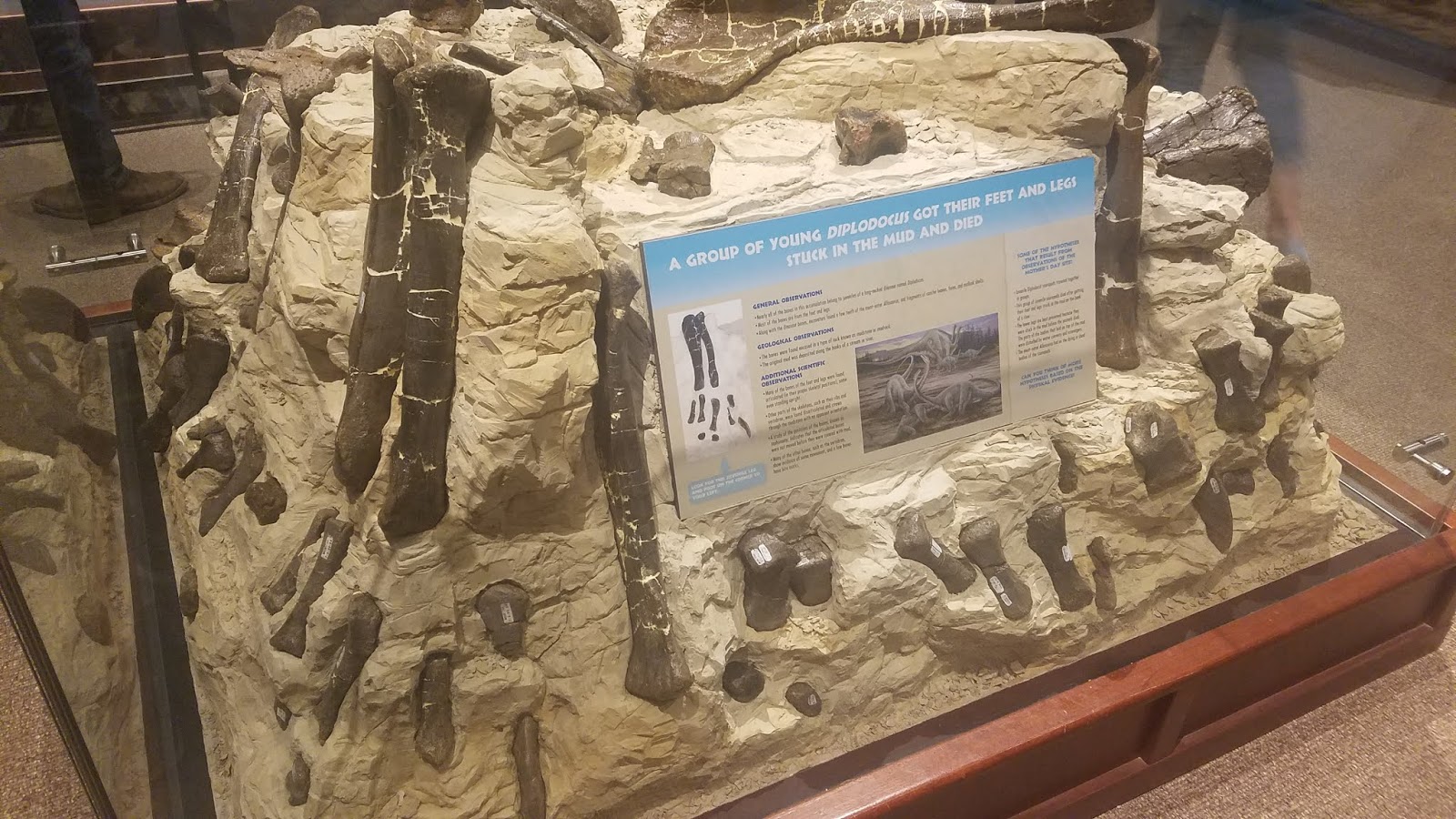
Feet and Leg Bones--they got stuck in the mud!

Comparison of Horned Dinosaur skulls as they aged

Tyrannosaurus again, with some other skulls of other T-Rexes

Neck of previously unknown dinosaur, still being studied
Ghengis Khan


Interior of Tar Paper Shack

Sunday, August 25, 2019

12 Million Years Ago

Overview of fossil site shown on live camera
Skeletons in situ labeled
2019-08-25 Sunday

Today was one of those days when we really feel as if we found a gem that hardly anyone seems to know about. We have waited for a year to get back to Nebraska to see Ashfall Fossil Beds State Park, and today was the day. We left our campground at 9:30, for a 2.5 hour drive (which took us 3 hours, with a stop for gas and slower speed than the speed limit allows.) As soon as we got out of the outskirts of York, the scenery became more and more rural until we felt we were driving into the middle of nowhere. The towns were all tiny, with no gas stations or much of anything, really. There was only one sizable town during the entire 135 mile drive.

Adult female barrel-bodied rhino
The park itself is in a gorgeous setting of hills, ravines, and green everywhere. And SO QUIET-- when we got out of the RV in the parking lot, all you could hear was the breeze and the crickets. Standing there with the cool air blowing lightly and the green hills all around, I would have been happy to just sit and drink it in for an hour or so. But of course, I was too eager to go see the fossils.

12 million years ago, the area of Ashfall was a semi-tropic area, and there was a water hole in that spot. The area was populated by a lot of mammals which are extinct relatives of our living rhinoceros, horse, camel, dog/cat (they have the same ancestor!), and loads of smaller mammals as well as birds. At that time, a volcano erupted in what is now southwest Idaho, and the volcanic ash blew eastward, settling as it came. A significant amount of it fell in what is now the Ashfall area. The animals in the neighborhood of the water hole died in that area--first the birds and small mammals, then the medium ones, and finally the largest, the rhinos. The winds blew the volcanic ash over the dead animals before the bones could be moved by weather or by carnivorous animals, and so as the ash hardened, the bones stayed as intact skeletons. The smaller animals with less lung capacity were affected by the ash in the atmosphere sooner, and the scientists think it took 4-6 months for the largest animals to be affected. Until they died, they were breathing what was essentially toxic ash, and many of them show signs of some kind of lung disease (I’m not sure how they can tell, but apparently they can) because they were breathing it longest, and inhaling the fallen ash with the grasses which they grazed on (most of them, other than the dogs, were herbivores.)
Bird (Crane) skeleton with lizard in its stomach
Complete skeleton of 3-toed horse

Unborn baby rhino in adult female


Because the bodies were protected by the ash, which is like crushed glass in texture, tiny details of the animals were preserved. So besides the skeletons being intact, there are details such as females with unborn fetuses still inside them (it was one of these skeletons, which is on display in Lincoln, which clued us in to the Ashfall area last year.) There is also one baby with the mother which seemed to be in a position to be nursing, with its head up under the ribcage of the mother animal. It is just amazing to see so many of these large animal skeletons totally complete. They are being preserved with a cement around them, because the bones are mostly not petrified. The exteriors are hard, but the interiors can crumble, and so the bones can be easily damaged. The first large group of animals to be uncovered were removed to protect them, but now the plan is to leave them where they are found for educational purposes. The site has student interns working there in the summer, slowly uncovering more of the site (I am so jealous-- I would love to work there!) The whole set up reminds me very much of the Mammoth Site in Hot Springs, SD, which we visited back in 2007.
Cassie checks out a petrified rhino bone

Baby rhino skeleton displayed at visitor center
We looked at the displays in the small visitor center for 20 minutes or so to get oriented to what we would be seeing, but we spent most of our time in the Rhino Barn, as it is called. The rhinos are the most common animal to be found at Ashfall. They have found (I think I remember reading) about 48 females, but only 6 males, and about 48 young rhinos. They think that maybe the rhinos behaved like some other modern animals, where there is one dominant male with a “harem” of females and their babies, which would account for the gender imbalance. In the case of other animals known to have this kind of social group, young males gather in “bachelor herds”, and they have found a group of all male rhinos about 150 miles away from Ashfall which supports this theory. I remember something similar was true with the mammoths-- the find in Hot Springs was mostly adolescent males, and they think that the females drove the males out of the herd and they fell into the sinkhole where they were found.
I took a lot of photos, and Joey and I both talked to the young intern from University of Montana who was working there today. He was answering a lot of questions from other visitors (there weren’t many of us, though!) and also had been working in the dig area when we first arrived. Besides the dig area itself, there were a lot of poster-size panels on the wall with color drawings of all the animals which had been found in the area (they found over 200 skeletons in the first dig--located outside the current Rhino Barn--alone!) There were also electronic displays around the railing which showed drawings of the various skeletons, giving their descriptions and (I loved this part) the name of the volunteer or student who had found each one! They are all numbered, and the skeletons left in situ are numbered correspondingly so you can see a number in the dig area, and then look at the details of what kind of animal it is, on the electronic display.

All in all, I think we spent 3 hours at the site, including drinking in the surroundings and reading the information panels outside describing the landscape (the entire area outside is, of course, part of the area covered with ash, but that layer is not visible except just around the Rhino Barn, where the ground is dug out to allow a sidewalk to walk “through the millenia” as we descended to the ash layer.

The animals species at the site did not become extinct-- they existed in other parts of what is now Nebraska and elsewhere, where presumably the ash was not as thick. So gradually many of these animals returned the the area, and their bones have been found in layers above the ashfall layer. Gradually the climate changed, the animals evolved or became extinct, and time went on. But the unique circumstances at the Ashfall area have given an incredible opportunity to see these animals without having to piece them together from various skeletal remains. We were totally in awe of the site, and felt it was well worth driving the side roads to find it.

We left the park at 5:00 (closing time!) and drove about an hour west until we found a small public campground in the town of Atkinson. Tomorrow will be a long day driving to the Black Hills.

Monday, August 27, 2018

NEBRASKA! GIANT MAMMALS! AMAZING!!

Elephant Hall display
Monday, Aug. 27, 2018

We got up a little earlier today so we could have time to spend in the Nebraska State Museum on the University of Nebraska campus in Lincoln. We drove 3 straight hours, getting close by at around noon, and stopping for lunch first. Then we negotiated the roads in the city, including on the campus of the university, until we came to the museum. It was located right by Memorial Stadium, the home of the Cornhuskers, which holds 90,000 screaming fans when it is full (and it has been sold out for every game since 1962!!)

Our problem was not 90,000 fans, however, but a parking lot made for cars, not for RVs. There actually was a section clearly labeled "For Museum guests ONLY!", but all the spaces were metered and were, of course, normal size slots for cars. We were lucky, I guess, because those spaces were half empty, including a stretch of about 10 of them in a row at the end of the parking lot. So we decided to park parallel to the side instead of like a normal car, and take up four whole spaces. This worked fine-- except of course, we had to stuff quarters into 4 parking meters to make ourselves "legal". Luckily, we also had a LOT of quarters (despite using up quite a few doing laundry last week, and using up others when we ran out of singles and needed to pay $12/night for camping at Stillwater campground.)

Early four-tusker elephant
Anyway, we each simultaneously slipped quarters into the meters until we'd put in enough for an hour (each quarter was only good for 12 minutes!!) I added a sign on the window for good measure saying "Visiting Museum", and we went inside.

We were immediately WOWed!!!  The museum is largely a museum of paleontology, and it turns out (who knew???) that Nebraska is a huge repository of... well, HUGE bones! They have found a complete fossil record of the development of elephants in Nebraska. There were more than 10 complete skeletons of elephants, beginning with some with 4 tusks (instead of only two), shorter legs, etc. and going to mastodons, mammoths, and modern elephants. ALL of which developed in Nebraska! They were fabulous!

Giant Mastodon (modern elephants in front of him)
In the next room over, we saw camel skeletons-- it seems a giant camel evolved in Nebraska, too. It was only later that they migrated into other continents. The llama, also, is a descendant of this camel; it ended up in South America. So both the dromedary (one hump) and bactrian (two hump) camels which are seen in the middle east and Asia, and the llama in South American, developed from the giant camel in Nebraska!

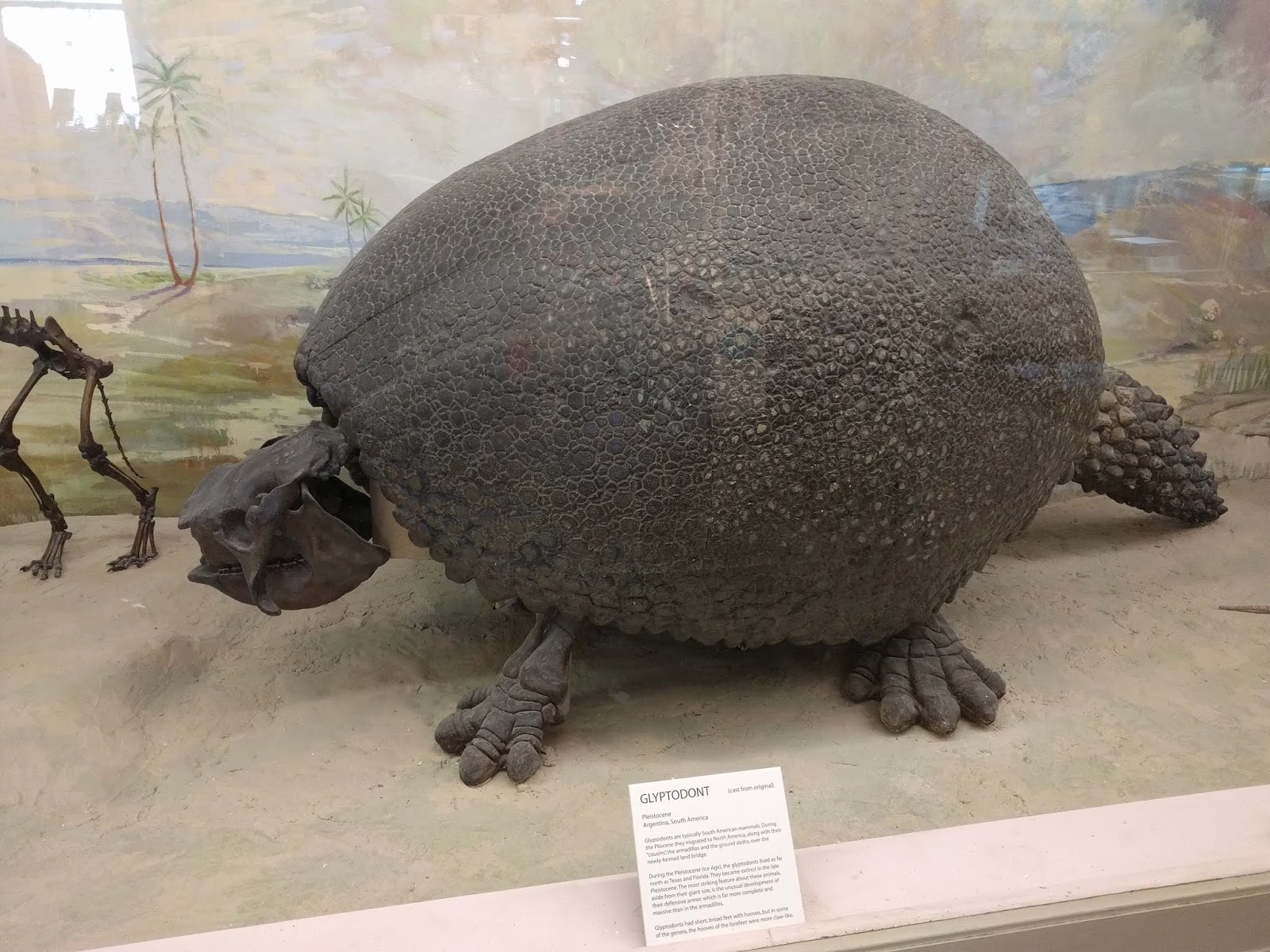
There were other galleries-- giant rhinos, horses (we should have come here instead of the Hagerman Fossil Beds!), one of "weird animals and fish", including a shark with teeth that looked like a buzz saw blade, large armored fish, and a 5 foot tall invertebrate of some sort which was just horrible looking! Speaking of horrible, there were several animals, some dead-end evolutionary "experiments", with truly ugly skulls. There were also skeletons of a giant sloth, a giant deer, and some kind of huge round THING, I can't remember what exactly it was (I'm posting a photo.)
Giant Camel

This floor of the museum was so utterly fascinating that we spent well over an hour in it--I had to run out and shove MORE quarters in our parking meters! We had about 30 minutes left to go upstairs where the "real dinosaurs" were-- including a stegosaurus which came from, guess where? Utah's Dinosaur National Monument! So we had visited the place it was buried, and here was the skeleton itself! They also had an Allosaurus from there as well. And in the room next door, there was a plesiosaur neck in the floor--it went from one end of the gallery to the other.

Plesiosaur skull and body found in Nebraska
This museum has a number of really rare fossils, such as a fossilized early deer which was pregnant, and the bones of the fetus were also fossilized. There is a giant something that I never heard of, which is very rare, and an entire flying dinosaur skeleton still embedded in rock for display-- it is rare to find an entire skeleton in one piece, so to speak. All in all, we simply were boggled by the richness of the fossil record in Nebraska, and plan to come back again. For one thing, we didn't find out until today about the Ashfall Fossil Beds in northern Nebraska. We easily could have stopped to see them on our way west a few weeks ago. They are a paleological version of Pompeii-- a volcano erupted in Idaho, killing hundreds of now extinct animals at a waterhole area in what is now Nebraska. I took a photo of one fossil from the site which was in the museum, but I am avid to go see the original site now, which, I believe, is also enclosed inside a building like Dinosaur National Monument is.

"Round thing"-- a Glyptodont, related to an armadillo
There was also an exhibit highlighting the fossils found through the State's "Highway Paleontology Program," where there is cooperation between the state and the scientists when new roads are being put it-- the paleontolgists work side by side with the road construction crews to deal with fossils that may be uncovered at the time of the work being done. It is one of the first cooperative programs of this type in the country. All in all, this was one of the most fascinating museums I've ever seen, and just standing in the "Elephant Hall" was to be in awe. As Joe said, Nature is truly incredible! This museum is worth a special visit-- I hope to go back there someday soon. We had to skip entire galleries due to lack of time and energy (and quarters!)
Complete flying dinosaur skeleton

By the time we finished up at the museum, Joe was pretty wiped out (he'd done almost all the morning's driving), so we found a park to stop in while we looked at our options for the rest of the day. There are a LOT of places to "overnight" in parking lots near Omaha (Walmart, Cabela's, Cracker Barrel, and even the highway rest areas), but we needed electricity tonight--it was in the 90s and SO hot, and we knew we wanted AC tonight.  In the end, we decided to go to a county park campground near Omaha, about 45 minutes further east. But when we got there, it was full.
Plesiosaur paddle

Allosaurus
Stegasaurus from Dinosaur Nat. Monument in Utah
Fossilized animal burrows (bottom one has animal remains in it)
A very weird animal-- I have no idea what!
So we did MORE thinking and mapping, and headed east again, crossing the Missouri River into Iowa until we came to another county park, Arrowhead Park in Neola, IA. We were lucky yet again to get one of the last spots available. So we are in Iowa now, about 2 hour's drive from tomorrow's destination. I can't upload today's photos because we have very little connection for some reason, but I will certainly do that. The skeletons we saw today were, as I said, mind-boggling! If they are not here when you read this blog, come back again!


I have no idea what this is!

Wednesday, August 22, 2018

Very Long Ago, and Very High Up

Sunday, Aug. 19, 2018

This was another one of our amazing days, I think! We woke up as planned, a bit early, because we knew we had a long day ahead of us. We just didn’t realize HOW long it would be!

Our first stop was, of course, the visitor’s center at Dinosaur National Monument. We first watched a 12-minute video about the dinosaurs and natural impact of the Green River Valley in that area. The reason there are so many dinosaur bones here is because the “ancestral Green River” washed a lot of bones into one spot. But as we learned, the site is misleading, because all the bones here are of huge dinosaurs-- the smaller bones were washed away or otherwise decayed before they ended up in the “dinosaur bone jam” in this particular location.

Wall entirely embedded with fossilized dinosaur bones
Then we hopped onto the tram which took us up through layers of earth to the viewing center. The building is fantastic-- it is built right against the original wall of fossils which were excavated in the first decades of the 20th century. You can’t help but go WOW when you first walk in and see the wall of bones still embedded into the rock.


There are excellent displays to help get oriented to what we saw. The large wall in front of us was originally about 3 times larger-- the areas above it and to the right and left were excavated earlier, as I said. The fossilized bones which were removed are now in museums all over the country, with three complete skeletons in the Carnegie Museum in Pittsburgh-- now on Joe’s and my list for a long weekend visit so we can see them. (Other bone are also closer-- in NYC and even one in a museum in Newark, DE, if I recall correctly!)

Allosaurus in rock
For $1.00 we purchased a brochure which helped us identify individual sections of the wall and better “see” the bones and how they belonged together (if, in fact, they actually did-- a number are just stray individual bones.) So we looked at them carefully, and Joe pointed out some specific bones which he could identify from his knowledge of anatomy. There were also a lot of panels with photos explaining how the bones were originally excavated, wrapped in burlap and then plaster, then put into boxes and pulled on skids down the mountain to wagons, and hence to the nearest railroad depot where they were shipped back east. The entire area was absolutely fascinating, and we spent at least an hour there.

Placement of bones in wall and reconstructed skeleton in NYC
We left the monument just about noon, and had to stop at an RV park in Jensen to dump our tanks, fill up with fresh water, and buy a bag of ice. Then we finally headed toward central Colorado, where we were meeting Ben and Miriam. I had already gotten a number of texts from Ben, and he was going to send us more info after they found a nice campground for us to meet up at.
Camarasaurus skull

Joe points to corresponding place on his hip
We headed east, crossed into Colorado, and stopped at the Welcome Center in Dinosaur, Colorado, to pick up some info. I chatted briefly with the two people working there, and pointed out the route I was planning to take-- it seemed like the most direct route--through Aspen and down toward Salida, which was the general area Ben was heading for. All they said was, “Well, that sure will be a pretty drive!” And then we continued on.

We stopped in Rangely for a lunch break, and then kept going. My plan included picking up I-70 at a town called Rifle, heading east to Glenwood Falls, and stopping there for a Walmart stop before continuing on. That looked to me like the exit to go south on my planned route, but my GPS kept telling me to go farther along I-70 before heading south, and I decided maybe that was a better idea, although it looked like more miles to me. But the GPS was calculating the fastest route, so I figured I’d trust it.

As we got on the interstate at Rifle, there I saw a Walmart! But it was too late, so we continued with the original plan to stop at the Glenwood Falls Walmart. This was only about 30 miles or so down the interstate, and we got off there. I quickly discovered that Glenwood Falls was actually a resort city, with a large hot springs hotel and pool there, and that the exit from the interstate put us right in the center of a charming but very busy downtown, full of cute looking businesses and restaurants and historical buildings. There was no sight of a Walmart anywhere, which we have come to expect when we use Next Exit to tell us what exits have Walmart. So we had to hastily look for a GPS guide to Walmart.

The GPS worked, although it first took us to a tiny road which was closed. We could at least see the Walmart from there, however, and used our own eyes to get us there. It turned out to be an older store, not a Super Center, and as such it 1) had a very small parking lot; 2) was relatively difficult to get to; and 3) did not have fresh veggies and fruits. However, we were able to get almost everything we wanted, with the exception of sufficient bottled water. The plus side was, it was a smallish store, so it didn’t take us a full hour to get through it.

My first inkling that this was a mistake
And then, we plugged our destination back in-- by now, we knew Ben was at Cascade Campground a little south of a town called Buena Vista. I found it on my map. And now the GPS told me to go MY original route-- keep heading south through Aspen, in almost a direct line to Buena Vista. So I figured, ok-- we’ll switch back to that route again.

Well! It was only about 10 minutes before I was having serious misgivings. Even though the road was a divided highway with 2 lanes each way, we were steadily rising, and I was having a very anxious feeling that we should have gone back to the interstate and use the GPS’s original suggestion. Soon enough, we got to Aspen-- and negotiated carefully through the center of town. And then the road was 2 lanes, and fairly narrow. But okay, this is Colorado, and we were going through the mountains, going up still. But it did seem narrower than I would have preferred, for sure.

Uh oh. The road didn’t have much in the way of a shoulder or a railing. There were a lot of hiking trails around, though. It seemed like a very SMALL road, although it was the only road there was! Unless we turned around and went all the way back to Glenwood Springs, that is.

Double uh oh!! We passed a sign that said, “Lights will flash automatically if vehicle oversized.” But they weren’t flashing, so.... we kept going. And a little further: “Turn around for over-sized vehicles,” with a pull-out. At least there was now a sign-- vehicles over 35' forbidden to proceed. We are under 30 feet. But man, that was NOT reassuring! What WERE we heading for, anyway?
Hairpin turn

We passed several forest service campground areas and a LOT of trail heads. Not much else. The road was not very wide. Whenever we passed ANYONE I had a small anxiety attack. And then a sign: “road narrows.” I said, “narrower than THIS??” And now suddenly the double yellow line disappeared-- the road was so narrow that if they’d put in a line, the space on either side would not have been wide enough! And, did I mention, we were on the OUTSIDE of the road, i.e. looking DOWN as we went around the side of the mountains? We came to at least three of these “narrow” sections. They were just terrifying, because they BARELY wide enough for two cars, but a car and an RV? They were NOT WIDE ENOUGH. And every single one went around the mountain, so we couldn’t see if anything was coming, although it usually was. At one point, we stopped JUST as the road narrowed, because I yelled STOP! to Joe. I could see that if we did not, we’d be face to face with a car and no room for either of us to pass. We waited until 4 cars went past us, then prayed as we went through ourselves.

By this time, I had my eyes closed at least half the time. The speed limit was 20 mph most of the time, sometimes only 15 and on some particularly sharp turns, 10mph. I was having a real panic attack, and practically ready to cry. Joe, meanwhile was doing GREAT. He drove the whole way in 1st gear most of the time, I think, and he was calm as could be. (I was also worrying because it was getting so late-- almost 7pm--and I thought he needed to eat soon! And also, my GPS kept telling me
Drop off on the right. No guardrail.
that the time between us and our destination was getting LONGER each time I checked!)

Finally, FINALLY, we came to the top-- beyond the tree line, to find a big pullout area and a sign that said, Continental Divide, 12,095 feet. Well, no WONDER I was panicking-- I was oxygen deprived! (Joe pointed out that airplane cabins are pressurized for 10,000 feet-- and that our oxygen masks would have dropped 2,000 feet earlier!) There were a number of people parked up there, with some information panels and even pit “restrooms.” Clearly, this was a “destination,” which is why we had so many cars passing us. I found out from the panels that this was Independence Pass, and it is the highest paved road in North American!!! Another panel mentioned that “the Narrows,” as they are called, have been panic-inducing since the pass was first used. No-Duh!!
"Road narrows". TOO NARROW!!

There was a short path to an even higher observation point. I was just unable to walk up it-- I was so shaky and weak and wobbly when I got out with Cassie, I almost fell over! There was a nice young man who offered to take my photo in front of the Continental Divide sign, and he asked which side we’d come from. I said, Aspen, and he reassured me that the other side was “much much easier,” that we’d come from the “hard side.” Honestly, I was VERY glad to hear it-- I didn’t think I could take much more! (Then he added that there were “only” about 3 more hairpin turns! And then I heard him tell his friend, “They came up in that RV!” and I could tell he thought THAT was a bit gutsy! But we had NO IDEA what we were getting into!!) Meanwhile, while I was outside, Joe checked his sugar, which was great, and he ate a little bit anyway so it wouldn’t drop at an inconvenient moment on our way down. Even Cassie got into the act, placing a “deposit” on the highest paved highway in North America!

Above the tree line
So I took some deep breaths (as deep as possible, that is) and we started rolling DOWN the mountain. Although it had its scary moments (we were still on the “outside”, and I could look straight down over the edge of the road to the valley below), it was nothing as bad as coming up had been--the road was wide enough for double yellow lines all the way, and the speed limit went all the way up to 35mph! By this time, though, I was worried about the time. I knew that the campground we were going to was NOT going to be well lit, and I was anxious about actually finding it. I’d originally thought we might get there at 7:30, and now it looked like being 8:30 or even later. We’d had no phone “bars” pretty much since we’d left Aspen, but when we finally came down from Independence Pass, they finally came back. I was able to call Ben, who reassured us that we were almost there and gave us a few more landmarks to watch for, and then we kept on.

We found our turnoff (after disregarding GPS’s suggestion of a side road--I’d had enough of THAT!) but by this time, it was dark. We drove slowly along a county road, and there was more traffic than I expected. It was entirely unclear from the map how far along we’d have to go, and we had trouble seeing some of the road signs. When we saw a sign that said “National Forest Campgrounds ahead,” we were SO reassured! But still there was mostly black road and not much else until I realized there were actually homes on this road, and then the Mount Princeton Hot Springs Resort, accounting for the oddly mystifying traffic. After we passed that, I got out our super-high-power flashlight, and I opened the window, and every time we saw any kind of sign, I held my arm out the window to illuminate it with the flashlight. And so we proceeded until, Eureka! The sign for Cascade Campground, and the turnoff. Then it was a relatively simple matter to make our way through the campground loop until we came to site 8, which Ben had reserved for us, and there he was, waving. So Joe got out and guided me while I backed in. And miraculously, it was flat!

It was 9:00 and pitch black in the campground, but Ben had the coals of a good fire going, so we sat and talked to him and Miriam (and Judah-bear, who is 14 months old and was wide awake). Joe soon went to lie down, and I sat with them just a little longer before realizing that this long day and all the adrenaline rushing during the couple of hours we drove over Independence Pass had really exhausted me as well. So we said goodnight, and I stumbled across to our campsite. Joe made us some scrambled eggs (we still hadn’t eaten) and then we passed out in bed.

Joe was FANTASTIC driving over that pass. He didn’t seem at all nervous, and he was in total control of the RV the entire time. I, on the other hand, apparently do not respond well to 1) heights; 2) lack of oxygen; 3) lack of knowledge of where I am going. I was a genuine wreck. According to Ben and Miriam, we have now negotiated the two “worst” (i.e. highest and scariest) roads in Colorado-- Independence Pass, and Route 550 from Durango to Ouray, which we did in 2015. But with the latter, we KNEW what we were getting into, and it was broad daylight. Today’s adventure was a total surprise, and turns out, I don’t do very well with those! But Joe was completely unfazed. So now we know whose nerves are better!

Thursday, August 16, 2018

My Plans Don't Always Work Perfectly

Wednesday, Aug. 15, 2018

I had high expectations for today. I knew where we were going, and I expected those places to be really interesting and varied. But none of it seemed to work out quite smoothly this time. It was a very bizarre day. [And, I might add, the title works for today's blog, as well. My phone refuses to send me any photos for today, and Joe's photos were mostly not great either, so until I can transfer a few of mine in here, there are no photos!]

Our first stop was the Minidoka National Historic Site. This site was one of the interment camps for Japanese citizens during World War II. Not a lot of physical remnants are there-- there are some walls from the police building at the site of the gate, and a couple of other buildings. But there is a recording we listened to of a man describing his journey from home to Minidoka, and what it was like for him. There is a fence which is a replica of the fence which surrounded the encampment, which enclosed thousands of Japanese. And there are some plaques, including a Wall of Honor which names the Japanese soldiers who fought in the US Army.

All of this information was in a very small area next to a very small parking lot. There is apparently a visitor center, but it’s about a half-mile away on a path. The signs explaining the path(s) (there are several) were very unclear. We set out, with water (which they suggested) and sun protection, and Joe’s walking stick, and instead of turning toward the visitor’s center, the path turned the opposite way. I realized we had taken the wrong direction, and that there was something more direct. Yes, it WAS my fault for not realizing that the brochure had a map in it! But it was VERY hot and I realized Joe was just not going to make it back to the parking area, and set out again on the more direct path (the one we were on was undoubtedly about a mile long.) So we went back to the RV, and I discovered that my phone had not even managed to take the photos I thought I had taken on our brief walk.
The fence around Minidoka. The internees fished in the canal.

Joe encouraged me to use my good camera, and at least get a few shots that way from the parking area. While I did that, he realized that there were three trash cans by the display signs, and lo and behold, they were for RECYCLING!! These were literally the first recycling containers we have seen on our entire trip thus far!! So we got all our plastic bottles and cans out of the RV, and filled up the plastic and can bin (the others were for trash, and for glass containers.) So at least THAT was a “win”! But I was disappointed not to see more information about Minidoka. From a physical point of view, I actually think the landscape is beautiful. But I think it must have looked like hell on earth to the Japanese who were forcibly moved there from the Olympic Peninsula in Washington, where everything is so green and lush and cool. The brochure tells of all the amazing ways they improved the camp during the years they were there--they were truly quite heroic. But the entire situation was certainly a shame on the history of our country.

Hagerman Horse skeleton 
So we left and drove to the town of Hagerman, about 45 minutes further west. This is the site of the Hagerman Fossil Beds, a National Monument. The fossil beds contain a great variety, quantity, and quality of fossils, most notably of the Hagerman Horse, the earliest true equine (meaning he had a single hoof.) Smithsonian scientists uncovered 120 horse skulls and 20 complete skeletons here, one of which is in the very small visitor’s center in downtown Hagerman. There were a number of other fossils displayed, of other animals (giant sloth, giant otter, mastodon, mammoth) and plants. But again, it was quite a tiny place! We had lunch by the town park, and then we drove out to the National Monument itself, which is along the banks of the Snake River (the Snake River is EVERYWHERE in Idaho!!) The site is quite near the town, but we did manage to take one turn (on the map it looked like the correct road) and end up at a bridge which was closed (this is what will happen when you ignore a sign that says “road closed”, when it appears to still be open!) No big deal, we found the correct way, passing fields full of “melon gravel” as we traveled. These are large rocks which were dropped (like pebbles or gravel) by retreating glaciers.

There were two overlooks in the area administered by the Nation Park Service. One was the Snake River overlook, which had some more info about the Pliocene Epoch, and a view across the river of the cliffs which are the actual fossil beds. In other words, we were nowhere near any fossils except in the visitors center-- and man, it was SO HOT up there that we didn’t even take Cassie out of the RV, the pathway to the overlook was too hot for her paws.

The second overlook was the Oregon Trail overlook. The other notable thing about this area is that the road goes right along the old Oregon Trail. So there were information panels on that as well. But as with the Minidoka site, in order to actually get to the overlook, it was necessary to hike a quarter of a mile or more (depending on which overlook you wanted) to get to the view. I got out of the RV briefly, but Joe was just too tired by that point. So we did our best to snap photos from the highway as we drove back down-- the road was so empty that it was not TOO unsafe .

At this point, it was about 3:30. There are two fish hatcheries right there in Hagerman-- one which is federally run, and one run by the state of Idaho. We had a magazine telling us all about the attractions in this part of the state, and while saying that both were open to visitors, with tours and other fun things to see, they said the State hatchery closed at 4:30, but the federal one was open until 6pm. So we decided to go see the federal fish hatchery.

Well, yet again, we followed the gps, and it led us to the gate of the Federal Fish Hatchery-- which was closed. There was no information. There was no sign about “hours.” There was a push-button phone set up at the gate, but no one answered it when I tried using it. We checked out a few other, unpaved, roads in the immediate vicinity, but none of them got us anywhere. Finally we took the road to the State hatchery, and we THINK it led us to the federal one, but we are not sure. And in any case, the fish breeding ponds were all locked up, and the rest seemed to be a series of ponds with, you guessed it, paths to walk between them. This being physically impaired business really cuts down on a lot of activities! And still, it was HOT (did I mention that?) So.... we were ready to give up for the day.

Which led us to the question, where were we going to stay? There are three places in Hagerman with RV parks attached to public hot spring fed pools. I had done a LOT of research trying to decide which to go to. I’m too tired to relate all of the details; suffice to say that our first choice did not have any RV sites free when we got there. So we are at their sister park across the road. And.... YAY! Finally, something worked out just right!

After not seeing all of Minidoka, after being a little disappointed in the Fossil Beds, after not finding the fish hatchery, after being turned away from our first choice of RV park, we FINALLY got something good! I was quite concerned because the RV sites themselves are quite unattractive, and ours seems to have mud (which none of the others do.) The electric hookup didn’t work, so we are using the one in the site next to us. The flies were driving me nuts, and it was so EFFING hot (did I mention that already?) that do what I could, I could not cool down. And the AC in the RV was fighting in vain against the heat. And adding insult to injury, there is not a single bar of telephone service. But tonight, after Joe made us a wonderful dinner (which we ate outside because despite the flies and yellow jackets, it was cooler out there), we went over to the pools.

And all I can say is, I wish the owners took as much care with the RV park as they did with the pools. The place is very clean, up-to-date, the showers inside are tiled and the water is hot. Better yet, the 4 hot spring-fed pools are delicious! The hottest one was as hot as ours at home, probably about 104-105 degrees, and Joe was so happy soaking in it. I went in all of them-- the biggest was “only” about 95 degrees or so, and the other two were about 100. But they all felt great, I was able to finally get physically comfortable, and it was just what we (I) needed to stop feeling aggravated and relax.

10,000 Springs
So we came back, Joe is reading, I did the dishes, the dog is half asleep, and the AC cooled the place down enough in our absence that I think we’ll be able to sleep comfortably. Joe says he had a wonderful day today and thought it was perfect (he considers all our detours and changes of plans to be “adventures” and is quite happy no matter what we do), but I always get a little bothered when my careful plans and research don’t entirely pan out. But hopefully, tomorrow will be a more successful day--I don’t have anything specific planned other than our final destination-- Lava Hot Springs, yet another hot spring experience! It was great in 2011, and I have hopes that it will not disappoint us this time.
10,000 Springs burst out of the cliffs

PS: One thing I forgot to mention was when we were driving to the RV parks, we suddenly looked across the river, and saw dozens of springs spilling down the sides of the cliffs opposite us. Despite hearing that the area was called 10,000 Springs, we were quite taken by surprise-- they were SO PRETTY!  We spent a little time trying to find a vantage point to see them better, but the best we could do was with my good camera's zoom lens. But just seeing them was a treat.